





BLOG
Low Noise Amplifier Basics: Working, Design & Applications
May 20, 2026
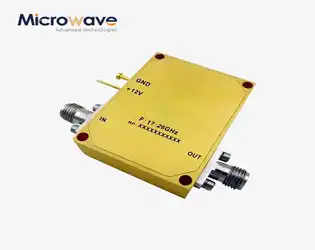
Low noise amplifiers (LNAs) are important front-end parts of RF and microwave devices because they boost weak signals with little noise. For unique designs, a low phase noise amplifier does more than just lower thermal noise; it also keeps the spectral purity very high, which is very important for radar, satellite communications, and precise time. Because these devices have both high gain and very stable phase properties, they are essential in mission-critical settings.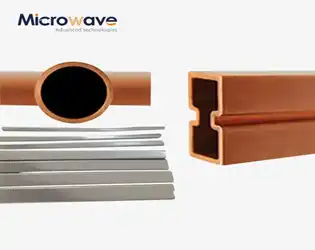
How Does a Waveguide Tube Reduce Signal Loss?
May 20, 2026
A waveguide tube lowers signal loss by keeping electromagnetic energy inside a hollow metal structure. This gets rid of the dielectric losses that come with coaxial wires. The waveguide tube is different from standard transmission lines because it sends data through carefully managed electromagnetic field patterns (TE and TM modes) inside its air-filled hollow. This makes the loss at microwave frequencies much lower. This design keeps shielding materials from absorbing energy and focuses the signal within carefully designed internal dimensions. This keeps reflections to a minimum and improves transmission efficiency for radar, satellite, and internet systems that need to work well.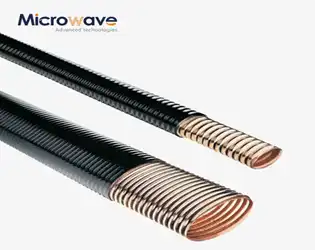
Elliptical Waveguide Design and Signal Performance
May 20, 2026
When engineers have problems with high-frequency microwave systems, like those used for defense radar, satellite ground stations, or internet infrastructure, the type of waveguide technology they choose has a direct effect on the dependability and purity of the signals. When it comes to adjustable transmission, the elliptical waveguide stands out because it is both low-loss and mechanically adaptable. Instead of fixed rectangular waveguides that need complicated installation with many flanges and bends, this curved design lets cables run continuously through tower structures and equipment racks, which cuts down on reflection points and installation work by a large amount. We at Advanced Microwave Technologies Co., Ltd. have seen how the right design and choice of materials in these parts can improve performance in mission-critical situations.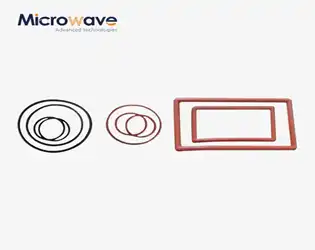
Waveguide Gasket Materials for RF Sealing Performance
May 19, 2026
Waveguide gasket materials are an important part of high-frequency radio frequency (RF) systems because they keep signals pure and stop electromagnetic disturbance, which can make or break a mission. These special seals are very different from regular industrial gaskets because they do two things: they keep out moisture and other contaminants, and they make sure that electricity flows smoothly across waveguide flange joints. Choosing the right material has a direct effect on insertion loss, voltage standing wave ratio (VSWR), and long-term dependability in a wide range of situations, from radar bands in the sky to satellite ground stations. When buying, teams know how different seal materials work, so they can match the specs of parts with the needs of operations.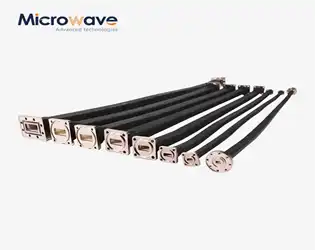
Flexible Twistable Waveguide Bending Radius Explained
May 19, 2026
The bending radius of a flexible twistable waveguide is the smallest curve that the part can safely handle without losing its electrical or mechanical integrity. Advanced Microwave Technologies (ADM) makes rectangular waveguides that can be twisted. Depending on the model, the minimum bend radius for the E-plane and H-plane is carefully designed to be between 35 mm and 330 mm. These specs have a direct effect on insertion loss, VSWR steadiness, and the quality of the signal as a whole. Engineers need to know about the bent radius to avoid phase distortion, impedance problems, and parts failing too soon in defense, aircraft, and satellite systems.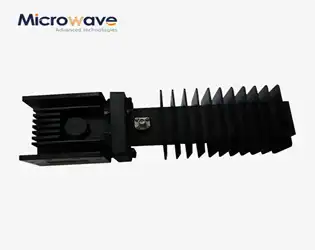
Why Are High Power Waveguide Isolators Critical in RF?
May 19, 2026
In radio frequency (RF) systems, high power waveguide isolators are very important because they stop mirrored signals from going backwards and damaging expensive transmitters, amplifiers, and klystrons. These non-reciprocal devices allow signals to flow in only one direction while absorbing reverse power. This is very important in places like radar installations, satellite ground stations, and high-power communication networks, where even small reflections can cause equipment failure, signal degradation, and expensive downtime. In mission-critical RF infrastructure, a high power waveguide isolator can mean the difference between safe operation and catastrophic component loss because it keeps the system stable under extreme power conditions, often handling kilowatts of power all the time.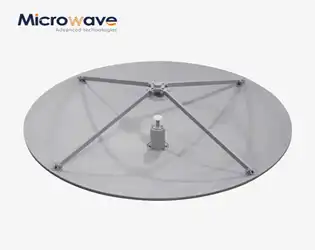
What is the design of Cassegrain antenna?
May 18, 2026
The Cassegrain antenna design is a complex two-reflector structure that was first adapted from optical telescope ideas for very good microwave and millimeter-wave functions. This design is different from most prime-focus parabolic dishes because it combines a big parabolic primary reflector with a convex hyperbolic secondary sub-reflector that is placed close to the focal point. Incoming signals are sent back toward the main dish's axis by the secondary reflector. This makes it possible to place feed components behind the primary reflector. This bent optical path greatly lowers transmission line losses and raises the gain-to-noise temperature ratios. It solves important problems in radar, deep-space tracking, satellite communications, and other areas where signal integrity is very important.
Microwave Parabolic Antenna for Long Range Links
May 18, 2026
Microwave parabolic antennas are the industry standard for point-to-point communication systems because they allow for stable, high-capacity wireless links over long distances. The shape of a parabolic reflector is used by these carefully designed antennas to focus electromagnetic energy into narrow, highly directed beams. This lets data be sent over tens of kilometers with little signal loss. The parabolic shape focuses microwave signals at a central point, where a feed antenna changes them into guided waves. These systems are essential for backhauling phone calls, satellite ground stations, defense networks, and connecting factories where fiber infrastructure isn't possible or is too expensive.