





How Much Power Can a High Power Waveguide Isolator Really Handle?
If you've ever asked this question mid-project, you're not alone. A high power waveguide isolator is a passive, non-reciprocal two-port device that transmits forward RF energy with minimal loss while absorbing reflected energy traveling in the reverse direction. Designed to protect transmitters, amplifiers, and signal sources from destructive VSWR spikes and impedance mismatches, these components routinely handle power levels from hundreds of watts to multiple kilowatts — depending on frequency band, thermal design, and ferrite material quality. Understanding the real power ceiling matters enormously in mission-critical systems.
Understanding High Power Waveguide Isolators and Their Power Limits
How Ferrite Materials and Thermal Design Define the Ceiling
In the middle of every waveguide isolator is a ferrite element that is pushed in one direction by a permanent magnetic field. When radio frequency energy comes into the waveguide housing, the gyromagnetic properties of the ferrite make sure that the information only flows in one way. The forward signal goes through with little insertion loss, and the energy that is reflected goes to a matched termination load where it is lost as heat.
These losses in heat are where the real power limit is. The device fails completely if the ferrite element goes over its Curie temperature, which is the point at which its magnetic qualities stop working. High-power waveguide isolator designs that work well and are stable are made with ferrite grades that have high Curie temperatures and housings made of aluminum or copper that carry heat well.
This is exactly why ADM's isolators are made of Al/Cu materials. Copper improves thermal conductivity, and aluminum lowers weight, so the received reverse power is lost before it builds up. The normal temperature range for these devices is from -40°C to +70°C, which is the temperature range they are designed to work in.
Typical Power Ratings and Frequency Bands
Waveguide isolators have a wide range of performance levels when used in real life. The standard high-power line from ADM can handle up to 1000W forward power (maximum), with a typical isolation of 20 dB and an insertion loss of only 0.3 dB over an 800 MHz bandwidth. The accuracy of these numbers has been proven by using a Vector Network Analyzer (VNA) to measure S-parameters across the entire working temperature range.
It's important to remember that even 0.3 dB of insertion loss at 1000W makes the device heat up by about 68W. Because of this, thermal management is not an afterthought; it is a main design constraint.
Comparing High Power Waveguide Isolators with Other Types
Waveguide vs. Coaxial Isolators: Where the Difference Becomes Decisive
Coaxial high power waveguide isolators work with less power, usually less than 100W, and are good for lab benches or low-power transmission stages. On the other hand, waveguide isolators work great in places where coaxial designs don't—in kilowatt-class transmitters, radar front ends, and satellite uplink amplifiers where ohmic heating in coaxial connectors is a problem.
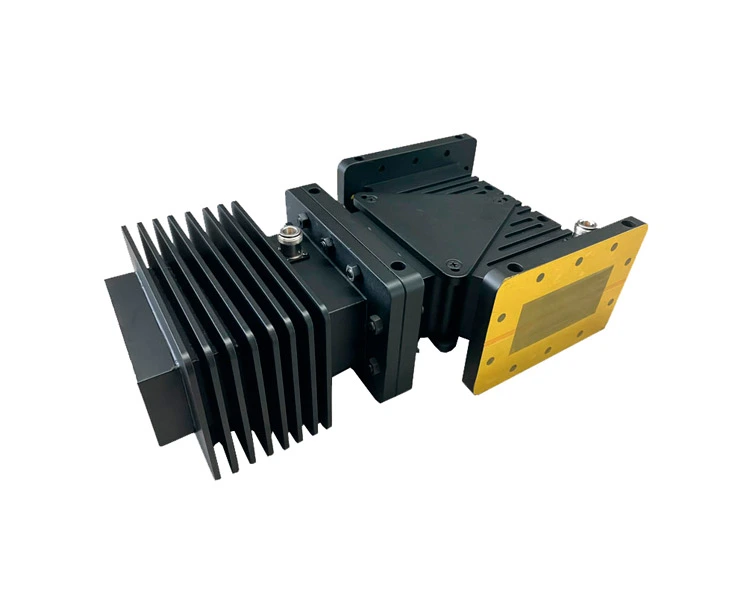
The most functionally similar thing is a circulator. A waveguide isolator is built like a three-port circulator, but the third port is closed off by a high-power matching load. The third port on the circulator can send energy somewhere else, while the isolator takes it in. The isolator configuration is best for high-power radar and industrial microwave applications because it gets rid of the need to manage a third signal path, which makes system integration easier.
At a glance, here's how these types differ:
- Coaxial isolators handle up to about 100W and work well with low-power signal lines; they come in small packages, but they can't handle echoes at the kilowatt level without breaking down.
- Ferrite circulators provide flexible routing across three ports, but the system engineer has to actively manage the third port, which makes the design more difficult in high-power situations.
- High-power waveguide isolators deliver superior power handling, lower insertion loss per unit power, and passive thermal management through robust metallic housings — making them the correct choice for radar, satellite HPAs, and industrial RF processing.
Each type fills a different need. If you choose the wrong class for a high-power chain, parts often break down too soon instead of losing performance slowly over time.
Selecting the Right High Power Waveguide Isolator for Your Applications
Key Parameters That Procurement Engineers Must Evaluate
Choosing the right high-power waveguide isolator takes more than meeting a stock frequency band. The following technical and purchasing criteria consistently define the choice of a good component:
- Isolation level (dB): Most transmission security situations need at least 20 dB; however, 30 dB or higher is needed for radar or industrial heating to keep the source from detuning.
- Insertion loss: At kilowatt levels, values at or below 0.3 dB are needed to keep self-heating from turning into a failure mode.
- VSWR: If the input and output ports have a value less than 1.20:1, the isolator won't add reflections to the chain it's protecting.
- Forward power rating: When checking the forward power rating, make sure you check both the average power (thermal limit) and the peak power (arcing cutoff) separately, as they are controlled by different physical processes.
- Environmental resilience: The operating temperature range, vibration tolerance, and corrosion resistance must match the environment where the system will be used. This is especially important for defense and aerospace platforms.
These criteria collectively shape both technical suitability and total cost of ownership. ADM's line includes different waveguide shapes and frequency bands. Reliability, cost, and ease of manufacture are all thought out during the planning process, not after the fact.

Practical Applications and Benefits of High Power Waveguide Isolators
Where These Components Deliver Measurable System Value
High-power waveguide isolators work in the background of some of the world's most demanding RF systems without making a sound. You can only tell how valuable they are when they're not there, like when a transmission stops working, a frequency is pulled, or an amplifier's life is cut short.
Here are the main environments where ADM's high-power waveguide isolators show their worth:
- Satellite earth station uplinks: SSPAs and TWTAs that send high-power signals face VSWR spikes when the antenna is pointed in the wrong direction or when the weather changes. These reflections are absorbed by an isolator before they reach the amplifier stage. This keeps the transmission going without any breaks.
- Radar transmitter chains: In S-Band and X-Band radar systems, high-power waveguide isolators are put between the magnetron or solid-state transmitter and the antenna feed to stop reflected energy from wrecking the pulse or the source.
- Feeder systems and T&M applications: ADM's isolators are designed to work with stable, repeatable signal conditions in test-and-measurement setups and feeder systems.
- Industrial microwave processing: Heating systems at the kilowatt level that work with variable dielectric loads cause reflections that are hard to predict. Isolators constantly take in this reverse energy, which lets the source keep its output fixed.
These applications share a common thread — the cost of a broken transmitter or amplifier is much higher than the cost of the isolator device that keeps it safe. Better signal integrity, shorter maintenance intervals, and longer machine life are not just engineering goals; they are real cash results.
Procurement Insights: Pricing, Lead Times, and Ordering Considerations
Matching Your Supply Chain Strategy to Product Complexity
High-power waveguide isolators have different prices depending on the material, frequency band, power rating, and level of customization. Standard stock units made of Al/Cu and with clear frequency bands have faster lead times and costs that are easier to plan for. Custom designs, like changed flange interfaces, higher working temps, or bandwidths that aren't standard, need engineers to work together and take longer to make.
ADM gives you both options. The supply chain for standard isolators is optimized to allow for fast delivery, and OEM and bulk purchase users can get custom frequency ranges, materials, and sizes that fit the needs of their systems. There is ISO 9001:2015 and RoHS compliance paperwork for procurement managers who buy from more than one area. This makes regulatory review easier during the defense and aerospace procurement cycles.
Conclusion
The maximum power that a high-power waveguide isolator can handle is not a single number. It depends on the qualities of the ferrite material, the thermal conductivity of the housing, the insertion loss, and the working environment. ADM's 1000W high-power line, which is made of Al/Cu and has 20 dB isolation and 0.3 dB insertion loss, is a mature engineering balance between performance, reliability, and cost. The right isolator design stops much more expensive failures further down the line, whether you're guarding a satellite uplink amplifier, a radar emitter, or an industrial microwave source.
FAQ
What is the maximum forward power for ADM's standard waveguide isolator?
The normal high-power waveguide isolator from ADM can handle up to 1000W of forward power and has an isolation level of 20 dB and an insertion loss level of 0.3 dB over an 800 MHz bandwidth.
Why does insertion loss matter so much at high power levels?
Even a 0.3 dB insertion loss causes a lot of heat inside the device when 1000W is applied. If the heat isn't managed properly with conductive housing materials, it can build up and push the ferrite element above its Curie point.
Can ADM customize the frequency band or flange configuration?
Yes, ADM offers OEM services that include changing the dimensions, frequency ranges, housing materials, and flange connections. During the prototyping and verification phases, engineering help is available.
What operating temperature range do these isolators support?
The isolators from ADM can work in temperatures ranging from -40°C to +70°C, which means they can be used outside, on airborne platforms, and in industrial settings.
How do I distinguish between average power and peak power ratings?
The device's ability to get rid of heat determines its average power. The voltage breakdown threshold inside the waveguide cavity sets the maximum power that can be sent. Both need to be checked against your system's working model on their own.
Request a Quote from ADM — Your Trusted High Power Waveguide Isolator Supplier
ADM offers precisely engineered microwave parts and has been making them for over 20 years. They also have ISO certifications and offer dedicated OEM support. Our line of high power waveguide isolators has low insertion loss, strong Al/Cu construction, and quick delivery to help you keep your system on schedule. You can email our engineering team at craig@admicrowave.com to look through all of our products and get a customized quote today.
References
1. Pozar, D. M. Microwave Engineering, 4th Edition. Wiley, 2011.
2. Helszajn, J. Ferrite Phase Shifters and Control Devices. McGraw-Hill, 1989.
3. Collin, R. E. Foundations for Microwave Engineering, 2nd Edition. IEEE Press, 2001.
4. Montgomery, C. G., Dicke, R. H., & Purcell, E. M. Principles of Microwave Circuits. MIT Radiation Laboratory Series, McGraw-Hill, 1948.
5. Bahl, I. J. Fundamentals of RF and Microwave Transistor Amplifiers. Wiley-IEEE Press, 2009.
6. Rizzi, P. A. Microwave Engineering: Passive Circuits. Prentice Hall, 1988.
YOU MAY LIKE
 VIEW MORESlotted Waveguide Array Antenna
 VIEW MOREWaveguide Twist
 VIEW MORERight Angle Double Ridged WG To Coaxial Adapter
 VIEW MOREWaveguide Anti-leak Gasket
 VIEW MORECoaxial Fixed Attenuator
 VIEW MOREDual Channel Coaxial Rotary Joint
 VIEW MOREMMDS Transmitting Antenna
 VIEW MOREDual Linear Broadband Dual Circular Polarization Horn Antenna