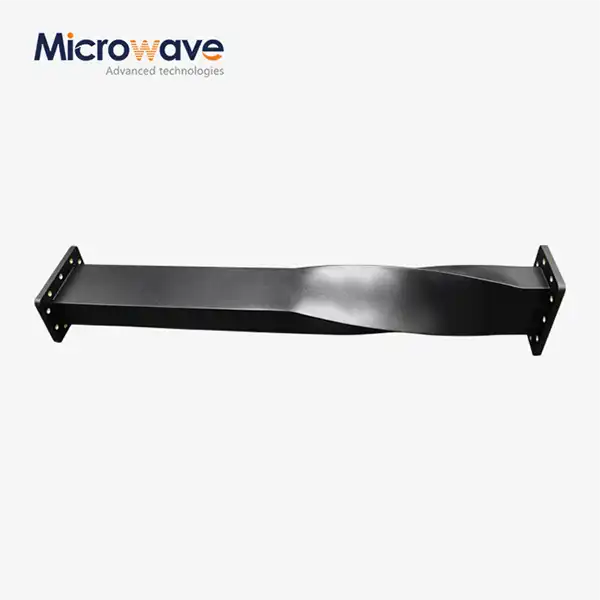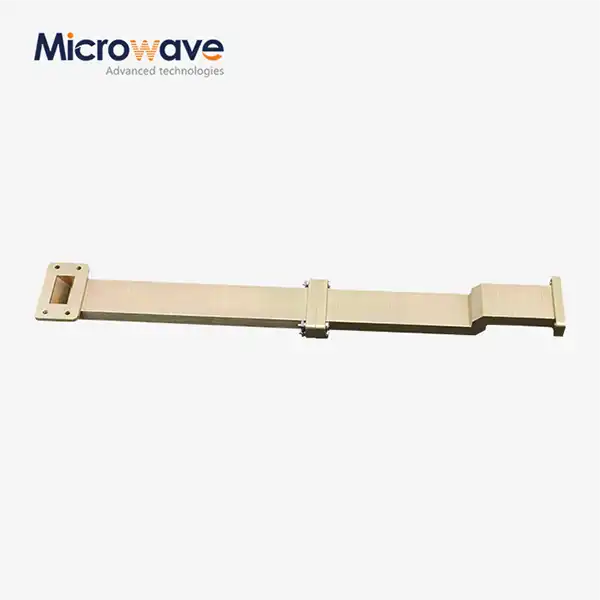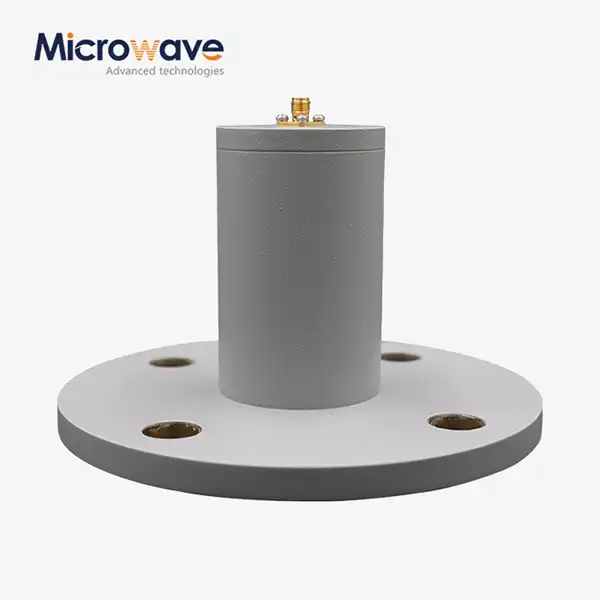






Industrial Microwave Isolator
Industrial Microwave Isolator for High-Power Systems
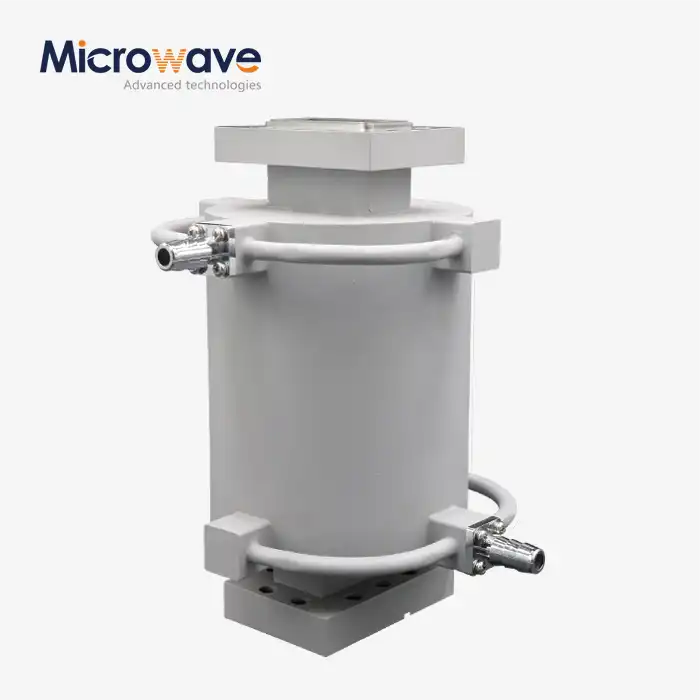
Advanced Microwave Technologies Co., Ltd. (ADM) designs and supplies Industrial Microwave Isolator units built for continuous-wave, high-power ISM-band environments. Operating at 915 MHz and 2450 MHz, each unit passes forward microwave energy toward the load while diverting reflected energy into a water-cooled dummy load. Isolation values reach 20–23 dB with insertion loss below 0.3 dB, covering power levels from 1 kW up to 100 kW and above — protecting magnetron sources from impedance mismatch across a range of demanding industrial processes.
What Is a Microwave Isolator and How Does It Work?
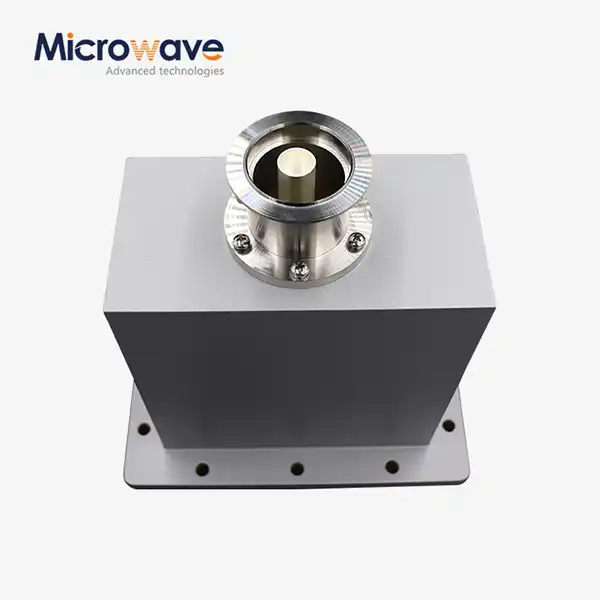
A waveguide isolator is a two-port, non-reciprocal ferrite device that transmits microwave power in one direction only — from the magnetron source toward the processing cavity.
Structurally, it is a modified circulator. A circulator is a 3-port device that routes power from Port 1 → Port 2 → Port 3. In an isolator, Port 3 is permanently terminated with a matched water-cooled dummy load, converting the circulator into a complete protection package.
When reflected power travels back from the load, the isolator diverts it into the dummy load and absorbs it, preventing it from reaching the magnetron.
Why Your System Needs an Industrial Microwave Isolator?
In industrial processing — drying, sintering, plasma generation, or food sterilization — the dielectric properties of the load change constantly. This creates impedance mismatches that send varying amounts of reflected power back toward the source.
Without protection, that reflected energy degrades the magnetron cathode, triggers mode instability, and shortens the operational life of expensive generator components. An Industrial Microwave Isolator absorbs reflected power, keeps the magnetron operating within its stable range, and reduces the risk of unexpected shutdowns during continuous processes.


Key Technical Specifications
ADM's isolators are engineered for high-power CW operation across standard ISM waveguide formats.
Parameter | Specification |
Operating Frequency | 915 MHz / 2450 MHz (ISM bands) |
Compatible Waveguides | WR975 (915 MHz); WR284, WR340, WR430 (2.45 GHz) |
Isolation | ≥ 20 dB – 23 dB |
Insertion Loss | < 0.3 dB (< 0.15 dB in premium ferrite designs) |
Power Handling (2.45 GHz) | 1 kW – 30 kW |
Power Handling (915 MHz) | Up to 100 kW+ |
VSWR (Input Port) | ≤ 1.20:1 |
Ferrite Material | Nickel-Zinc or high-grade Garnet ferrites |
Cooling Method | Water-cooled (ferrite section + dummy load) |
Hydrostatic Pressure Test | 6 – 10 bar |
Ferrite Material and Thermal Stability
Nickel-Zinc or high-grade garnet are used in the ferrite elements because they can handle high Curie temperatures. This choice was made to lower the chance of magnetic detuning happening during long-term processes with changes in temperature.
If the temperature of the cooling water gets too high or the flow rate slows down, the ferrite can get close to its Curie temperature and lose its magnetic properties, which makes the isolation numbers go down. The water coming in should be less than 25 °C, and the flow rates should match the kW dissipation curve from the manufacturer.
The water-cooling circuit's job is to get rid of the heat that is generated by ferromagnetic resonance absorption. This keeps the ferrite material working in a stable range.
Application Scenarios
People use these Industrial Microwave Isolators in places where load resistance changes a lot or where unplanned downtime costs a lot.
Microwave Plasma CVD (Lab-Grown Diamonds)
In this case, systems often run for long amounts of time without stopping. The isolator keeps the electromagnetic environment stable for generators with 6 kW to 30 kW and helps protect against echoes that change direction due to plasma fluctuations.
Industrial Food Dehydration and Sterilization
The dielectric loss factor goes down as food goes from wet to dry, which can cause sudden reflection surges. The isolator soaks up these surges and helps keep the generator from triping when spices, meats, or grains are being processed in bulk.
Pharmaceutical Drying by Vacuum
When there is a vacuum, the breakdown voltage in the waveguide path is smaller. By soaking up reflections that could cause high standing voltage peaks, high-performance isolators help keep the magnetron window from arcing.
Quality Control and Testing Protocol
Every unit shipped from ADM goes through a structured inspection process. Purchasing managers and system integrators can request full test documentation.
· S-Parameter Verification (VNA Testing): Full sweep across the operating bandwidth. Pass criteria: S21 < −0.3 dB, S12 < −20 dB, S11 < −20 dB.
· Hydrostatic Pressure Testing: Cooling channels tested at 6–10 bar to confirm zero leakage. Water ingress inside a waveguide system causes immediate arcing.
· High-Power Thermal Cycling: Unit tested at 110% rated power with a 100% reflection simulation (short circuit plate) to verify ferrite bonding and load capacity under worst-case conditions.
· Dimensional Tolerance Checks: Flange flatness and waveguide aperture alignment verified to prevent RF leakage at connection points.
FAQ
Q: After an hour of running, why does my isolation value go down?
A: I think this is caused by the ferrite losing its tune due to heat. If the flow rate or temperature of the cooling water is too low or too high, the ferrite gets close to its Curie temperature and stops being magnetic. Make sure the water coming in is less than 25 °C, and compare the flow rates to the kW dissipation chart.
Q: What if I only run the 6 kW isolator at 50% power? Can I use it for a 10 kW system?
A: There is a big risk in this. Front power might be fine at 50%, but the fake load is made for backward power. A full-reflection event, like an arc in the hollow, will send more load energy than the 6 kW unit can handle. Always get an isolator that is the same size as your generator's peak output.
Q: What is the schedule for keeping these things in good shape?
A: The cooling system is what maintenance is all about. Once a month, make sure that water strainers aren't clogged, and keep the conductivity of the water low to keep cooling channels from rusting and electrolysing. Once a year, check RF surfaces for carbon tracking.
Q: What's the difference between a circulator and an isolator?
A: A circulator has three ports. One product is a circulator that is permanently linked to a matched water-cooled dummy load through Port 3. In an industrial setting, you buy the whole protection package, including the circulator and the load, as a separate unit that has already been put together.
Q: There is an arc in my system at the isolator plate. What's the reason?
A: This is usually a sign of a bad RF seal or an out of alignment flange. Always use the right RF gasket, which can be a metal shim or twisted wire. Also, check to see if the cooling lines' condensation has reached the inside of the waveguide, since moisture can cause arcing.
Q: What kinds of waveguide interfaces can be used?
A: For 915 MHz systems, ADM's isolators work with WR975, and for 2.45 GHz systems, they can work with WR284, WR340, or WR430. You can get custom flange configurations; just get in touch with the ADM team with your specific interface needs.
Contact Us
For technical inquiries or sourcing support for an Industrial Microwave Isolator, reach ADM's engineering team at craig@admicrowave.com. We respond to specification questions and custom configuration requests directly.