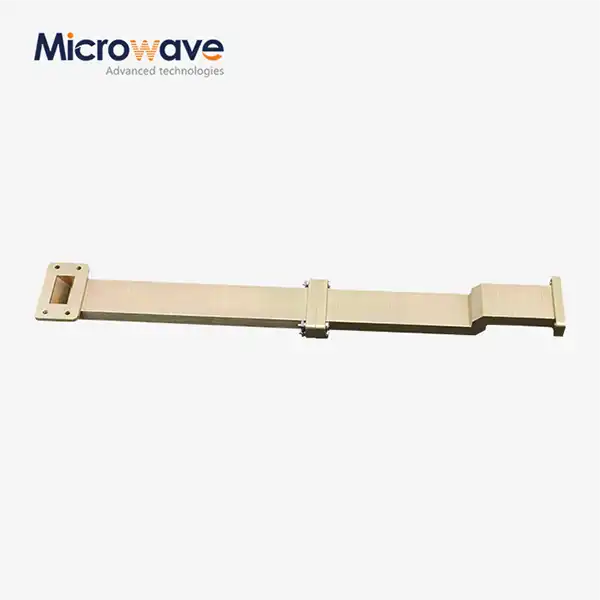






Flexible Waveguide
Flexible Waveguide Components for RF and Microwave Systems
Advanced Microwave Technologies Co., Ltd. (ADM) is a manufacturer of flexible waveguide components for RF and microwave transmissions in communication, radar, aerospace and test systems. Each unit is a mechanical bridge between two rigid sections of waveguide. It allows for misalignment, vibration and thermal movement while maintaining low-loss signal transmission. ADM has a 24 meter microwave darkroom and is capable of testing from 0.5 GHz to 110 GHz. They also have over 20 years of experience in developing waveguides. Some types of flanges can be ordered in standard configurations or in custom lengths.
What Is a Flexible Waveguide and Why Does It Matter?
If a solid connection cannot be made, there is a product, a passive RF transmission portion, which connects two waveguide sections. This is the case when flanges are not properly aligned during assembly, when radar structures are constantly moving, or when hard plumbing cannot be routed along non-linear lines within aeroplanes and naval ships.
This complicated metal core can be formed from strips of brass, phosphor bronze or beryllium copper, or a continuous corrugated tube. This allows the guide to bend, twist and stretch without impacting the quality of the RF signal. The exterior is protected from water, corrosion and wear by a Neoprene, Silicone or Polysulphide rubber jacket.
It deals with three engineering problems:
· Mechanical tolerance mismatch: Bridges the assembly gaps when connecting transmitters to antenna feeds in complex RF equipment.
· Vibration and heat stress: Absorbs structural movement to protect flanges in radar and satellite ground station installations.
· Limited routing space: Directs signals on non-linear channels in aircraft, naval vessels and tiny telecom cabinets.
Twistable vs. Non-Twistable: Choosing the Right Design
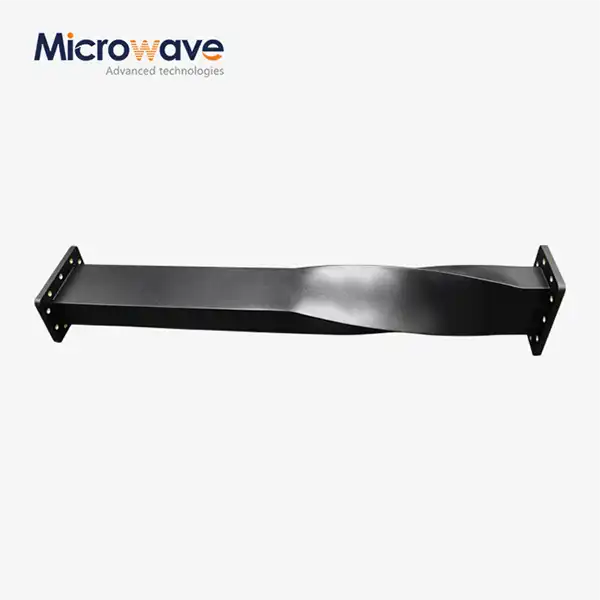
Metal strips wound around a helix are used to make a twistable object. This structure can both rotate and bend, and it is sealed with a rubber jacket. It works well for setups that need to twist and bend during assembly.
The Non-Twistable (Seamless) Flexible Waveguide is made up of a single corrugated metal tube made of phosphor bronze, brass, or beryllium copper. There are no joints or connecting strips in this tube. This construction is seamless, which gives you:
· Hermetic sealing for high-vacuum and pressurised systems, like medical LINACs and equipment used to make semiconductors.
· Elimination of Passive Intermodulation (PIM), since there are no metal-to-metal friction places that make noise.
· Better sealing against the environment than twistable types in RF paths that go outside or through vacuums.
For high-vacuum or satellite uplinks where PIM and sealing integrity are very important, the smooth non-twistable type is the preferred option.


Key Technical Properties
Parameter | Specification |
Core Materials | Brass, Phosphor Bronze, Beryllium Copper |
Jacket Materials | Neoprene (standard), Silicone (high-temperature), Polysulfide / UV-resistant coatings |
VSWR | Typically < 1.10:1 across operating band |
Insertion Loss | < 0.1 dB per foot (X-band, silver-plated interior) |
Operating Temperature | −55°C to +85°C (defense/airborne grade) |
Flexibility Types | Twistable / Non-Twistable (Seamless Corrugated) |
Bend Radius Types | Static Bend Radius / Dynamic Bend Radius |
Standards Compliance | MIL-DTL-287, IEC 60153 |
Frequency Testing Range | 0.5 GHz – 110 GHz |
Silver-plated interiors reduce attenuation in the corrugated sections. Both static and dynamic bend radius values should be confirmed before installation — exceeding the minimum bend radius deforms the internal convolutions, causing impedance mismatch and potential mechanical failure.
Application Scenarios
Satellite Communication (Satcom / VSAT Earth Stations)
High Power Amplifiers (HPAs) are linked to antenna feed assemblies by this product. The bendy part keeps sensitive electronics from being affected by antenna dish shaking due to wind loading or satellite tracking motion. This helps keep the uplink and downlink stable.
Defence and Radar in the Air
For fighter jet and shipboard radar systems, the interface between a gimbaled antenna and a stationary bulkhead requires a component that can withstand strong G-forces, temperature variations from −55°C to +85°C, and continuous dynamic bending while maintaining the phase performance.
Microwave Systems for Medicine and Industry
The flexible waveguide in MRI machines and industrial heating conveyors carries high power RF energy from magnetrons to closely spaced applicators. The repairman can get to the RF assembly without disrupting the whole apparatus, and it keeps the high-voltage transformers from rattling around, thanks to its flexibility.
Testing Capability
ADM features a 24 meter long microwave darkroom with a near and far field antenna plane monitoring recombination chamber. The system also allows the user to switch between near-field and far-field measurement modes, and test the performance of waveguide and antenna systems from 0.5 GHz to 110 GHz. This covers microwave frequencies used in traditional systems and millimeter-wave frequencies used in 5G backhaul and advanced radar.
Waveguide parts are tested for electrical and mechanical requirements in accordance with MIL-DTL-287 and IEC 60153 prior to shipment.
Customization and Supply Options
For both standard and unique needs, ADM supports custom configurations:
Custom lengths and bend shapes to fit unique installation plans.
You can choose a cover flange, a choke flange, or sliding/rotating flanges for assemblies that need to be aligned correctly.
Choose the right jacket material based on the working conditions, such as UV light outside, hot temperatures, or systems with pressure.
Designs for each frequency band, from L-band to W-band.
Flanges that don't match up are a common reason why installations fail. The engineering team at ADM can help match flange specifications during the design phase, which lowers the chance of having to do extra work after delivery. Craig@admicrowave.com with your system needs to talk about configurations.
FAQ
Q: What's the difference between a product that can be twisted and one that can't?
A: Twistable types have interlocking strips that are wound around each other and can be bent and twisted. They are covered with a rubber jacket. Seamless types that can't be twisted are made from a single metal tube that is corrugated. They offer better sealing and lower PIM for vacuum or pressurised applications, but they can't be twisted in any direction.
Q: Can the product handle the same power level as a rigid guide?
A: Because of heat buildup in the convolutions, power handling is usually a little lower. This difference isn't very big in most situations as long as the movable part is kept short and the system is properly cooled or pressurised. Check with ADM to make sure the power limits are right for your band and configuration.
Q: What takes place when the minimum bend radius is gone?
A: Going beyond the minimum bend radius changes the shape of the internal convolutions, which leads to impedance mismatches (higher VSWR) and the possibility of lasting mechanical failure. Before routing, you should always check both the static and dynamic bend radius specifications.
Q: What does it matter what kind of jacket I wear?
A: Neoprene suits general indoor use. Silicone can handle high heat. For long-term outdoor installations, coatings that are resistant to UV light are needed. If you choose the wrong jacket material, corrosion and seal failure can happen quickly.
Q: How do I choose the right type of flange?
A: Make sure the flange standard fits with the rigid system you already have. For example, WR-90 cover vs. choke flange. Make it clear if the flanges need to slide or rotate to fit properly during installation.
Q: What standards does ADM's bendable waveguide meet?
A: ADM makes products that meet international standards IEC 60153 and US Military Specification MIL-DTL-287.
Contact Us
Send your specifications or technical questions to craig@admicrowave.com. ADM's engineering team is available to support custom flexible waveguide configurations and flange matching requirements.