





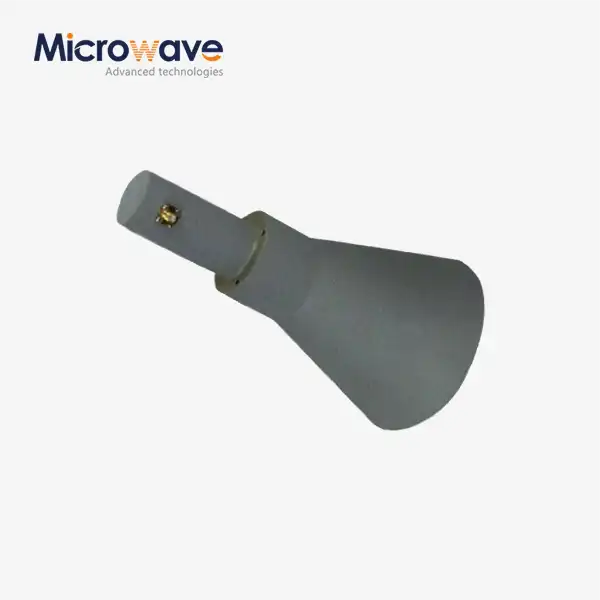
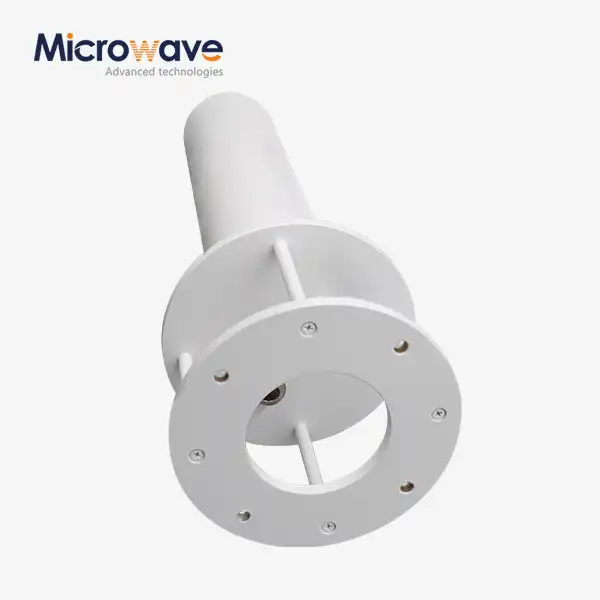
Ladder Membrane Conical Dual circular Polarization Horn Antenna
Ladder Membrane Conical Dual Circular Polarization Horn Antenna — Precision Feed Solution for Satellite, Radar & mmWave Systems
The Ladder Membrane Conical Dual Circular Polarization Horn Antenna from Advanced Microwave Technologies (ADM) uses a double-port conical horn with an internal stepped dielectric membrane to produce simultaneous Left-Hand Circular Polarization (LHCP) and Right-Hand Circular Polarization (RHCP) outputs. The axial ratio is usually less than 3 dB (less than 1.5 dB at the center band), the port isolation is more than 25 dB, and the VSWR stays below 1.5:1. The design is for uses where both pure polarisation and a small size are important.
What Is a Ladder Membrane Conical Dual Circular Polarization Horn Antenna?
Other antennas do not have a precision-machined conical aperture and a stepwise dielectric membrane polariser incorporated directly into the feed horn throat. The phase of the membrane is changed by 90 degrees, converting two separate linear modes into simultaneous LHCP and RHCP signals with high cross-polarization discrimination. No need for an external wave guide polariser.
This built-in integration solves three problems that satellite and radar systems often have: narrow bandwidth from regular septum polarisers; signal loss from Faraday rotation and multipath effects; and extra system complexity from external polarisation parts.
Key Technical Specifications
Parameter | Typical Value |
Polarization | Dual Circular (LHCP + RHCP) |
Axial Ratio (AR) | < 3 dB (< 1.5 dB at center band) |
Port Isolation | > 25 dB |
VSWR | < 1.5:1 |
Gain Range | 10 dBi – 25 dBi (aperture dependent) |
Operating Temperature | -40°C to +85°C |
Membrane Material Options | PTFE, Kapton, Rogers low-loss dielectric |
Body Material Options | Corrosion-resistant aluminum or brass |
Conductive Plating Options | Gold or Silver |
Core Design Advantages
Metal Septum vs. Ladder Membrane
The Ladder Membrane Conical Dual circular Polarization Horn Antenna uses a stepped dielectric substrate to create phase delay, while a traditional septum relies on a stepped metal wall. At millimeter-wave frequencies, it is hard and expensive to machine a metal septum to the right size. Lithography or laser etching are used to make the dielectric membrane lighter and more accurate in terms of its dimensions.
Reduced Weight for Aerospace Use
When you replace a solid metallic septum with a dielectric membrane, you get rid of a lot of mass from the feed assembly. This is important for satellite payloads and airborne platforms that need to keep their weight down.
Pattern of Stable Radiation
The conical shape creates a radiation pattern that is symmetric around rotation. This means that the gain and beamwidth stay the same no matter what the rotational orientation is, which is important for tracking and measurement systems.
Application Scenarios
LEO Satellite Ground Stations
When tracking a satellite in low-Earth orbit, its polarisation vectors keep moving around in relation to the ground station. The two-port design directly handles these rotating polarisation vectors, which lowers polarisation loss during fast tracking passes.
5G/6G and Automotive Radar OTA Testing
In Over-the-Air (OTA) anechoic chamber testing, the circular polarisation of the antenna lets engineers describe the 3D radiation patterns of the devices being tested without having to physically rotate the measurement antenna. This makes near-field scanning setups simpler mechanically.
Remote Sensing and Meteorological Radar
The dual-polarization output lets a weather radar device look at the differences in reflectivity and phase shift between polarisations, which helps tell the difference between snow, hail, and rain. The stepped membrane design helps keep the phase stable when temperatures change in radome settings outside.
Quality Control Standards
Each unit is processed through a structured QC process before shipping
VNA S-Parameter Testing: Each antenna is swept across its full frequency band by a Vector Network Analyser, checking VSWR, return loss and port separation.
Measurement of Far-Field Patterns: ADM has its own 24 m microwave darkroom with an Antenna Plane Near and Far Field Measuring Recombination Chamber that can measure 3D radiation patterns such as gain, beamwidth, sidelobe levels and axial ratio at different frequency points.
Dielectric Membrane Inspection: Small scale examinations are conducted to confirm the ladder structure has no etching faults or substrate delamination that may hinder its ability to shift phases.
Environmental Stress Screening : Testing for MIL-STD-810 aerospace applications. These include vibration testing and thermal vacuum cycling to verify the structure of the membrane and its venting of gases.
ADM's testing capability covers frequencies from 0.5 GHz to 110 GHz, supporting microwave and millimeter-wave product verification for the Ladder Membrane Conical Dual circular Polarization Horn Antenna.
Customization and Supply Information
ADM can make custom solutions for certain frequency bands, aperture sizes, connector types, and material requirements. The aperture width can be changed to change the gain range from 10 dBi to 25 dBi.
The engineering team can help you with mechanical interface needs, radome compatibility, and environmental requirements for projects involving space, satellites, or radar. Get in touch with the team at craig@admicrowave.com early on in the design process to make sure you agree on wait times and tolerances.
FAQ
Q: How much power can this antenna handle?
A: Compared to air-dielectric metallic horns, the dielectric membrane limits the amount of peak power that can be handled. Before deploying high power, you should check the breakdown voltage and heat dissipation limits of the membrane material used in your unit. This could be PTFE or Kapton.
Q: Can it work in the linear polarisation mode?
A: It's made to be a dual circle polarisation antenna. You can make linear polarisation by sending signals to both the LHCP and RHCP ports at the same time through an external hybrid network that controls the phase and amplitude relationship. The antenna can only work as dual-CP without that outside network.
Q: Why does axial ratio matter in this design?
A: It is calculated that the ladder steps will give an exact 90-degree phase shift. If the axial ratio drops by more than 3 dB, the antenna creates irregular polarisation, which causes cross-polarization interference and signal loss in systems that use different polarisations. Because of this, axial ratio testing is an important part of the quality control process.
Q: What kind of maintenance is needed for long-term use outside?
A: The antenna doesn't do anything. It is suggested that the radome and connector interfaces be checked once a year. Over time, phase balance and impedance matching can become less accurate if moisture gets into the radome or if UV light damages it.
Q: What kinds of uses does this antenna work best for?
A: It works well for LEO satellite ground stations, 5G/6G and car radar testing chambers, meteorological radar systems, and space payloads that need light feed sources with high polarisation purity.
Contact Us
Email about the Ladder Membrane Conical Dual circular Polarization Horn Antenna to craig@admicrowave.com and the ADM engineering team will respond with specific recommendations.
YOU MAY LIKE
 VIEW MOREConical Horn Lens Antenna
 VIEW MOREFeed Fired Lens Antenna
 VIEW MOREWideband Double-ridged Horn Antenna
 VIEW MOREMini Wideband Double-ridged Horn Antenna
 VIEW MOREOpen Boundary Dual Linear Polarization Four Ridged Horn Antenna
 VIEW MOREDual Linear Broadband Dual Circular Polarization Horn Antenna
 VIEW MOREPyramidal Linear Polarization Horn Antenna
 VIEW MOREQuadrifilar Helix Antenna