





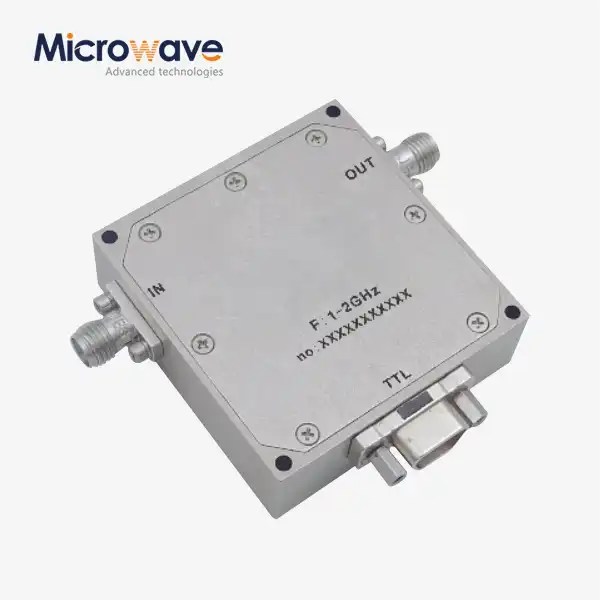
Digitally Controlled Phase Shifter
Digitally Controlled Phase Shifter — DC to 40 GHz RF Phase Control Solutions for Phased Array and Beamforming Systems
Advanced Microwave Technologies (ADM) creates and creates a group of Digitally Controlled Phase Shifter products that work from DC to 40 GHz. These parts, which are made on switched delay line, high-pass/low-pass network, or vector modulator designs and have TTL/CMOS logic interfaces, provide accurate phase control across discrete digital states. Digital control is better than analogue because it doesn't depend on noise in the control voltage or thermal drift. This makes it ideal for harsh RF settings where phase consistency is important.
What Is a Digitally Controlled Phase Shifter?
A product (DCPS) is a precise RF/microwave part that changes the angle of the transmission phase of an input signal by a set amount that can be determined by logic. Each phase state is chosen by a binary control word, which gives stable, repeatable outputs like 0°, 5.625°, 11.25°, and so on, all the way up to the full phase range.
To meet real-world engineering needs, this design provides high repeatability in automated test systems, gets rid of the need for manual tuning in phased array antennas, and speeds up beam steering in radar and communication platforms. When you connect straight to FPGAs or digital controllers, you don't need analogue tuning circuits, which makes system integration easier.
Key Technical Parameters
Bit Resolution and Phase Step
The phase step size (LSB) is set by the number of control bits, which is usually between 4 and 8. A 6-bit shifter gives you a 5.625° step, and more bits lowers quantisation error and lets you control the beam more precisely in array applications.
Speed of Switching
GaAs/GaN FET-based designs can switch between states in about 20 to 500 ns, which makes them good for time-division duplexing (TDD) and fast radar patterns.
RMS Phase Mistake
Units keep the RMS phase error within 2° to 5°, which helps multi-element antenna arrays have accurate beam direction.
Changes in Insertion Loss
The difference in insertion loss between phase states is kept below 0.5 dB. This stops unwanted amplitude modulation and makes it easier on gain correction circuits further down the line.
Linearity
Complex modulation schemes can be used with high linearity without causing a lot of signal distortion. This is useful for wideband communications and multi-tone test environments.
Product Specifications
Parameter | Specification |
Frequency Range | DC – 40 GHz |
Bit Resolution | 4-bit, 5-bit, 6-bit, 8-bit (customizable) |
Phase Step (6-bit) | 5.625° |
RMS Phase Error | Typically 2° – 5° |
Insertion Loss Variation | < ±0.5 dB across all states |
Switching Speed | 20 – 500 ns (GaAs/GaN FET) |
Control Interface | TTL / CMOS Logic |
Operating Temperature | -55°C to +85°C |
Custom Options | Frequency range, phase resolution, form factor |
Application Scenarios
Arrays that are Actively Electronically Scanned
Digitally Controlled Phase Shifter modules are built into array elements in defence and aerospace radar systems to electronically steer beams without turning them. Digital control lets you quickly and reliably change states for a lot of elements.
Massive MIMO infrastructure for 5G
Phase shifters are used in telecom equipment to direct millimetre waves toward user equipment. This makes the use of spectrum more efficient in situations with a lot of equipment.
SATCOM on the Move
DCPS modules fix phase alignment in real time to keep the link stable with geostationary or low-Earth orbit (LEO) satellites in aviation and marine connectivity systems while the platform moves.
Test Systems for Microwaves
In test environments that are automatically run, direct FPGA or computer control through a digital interface gets rid of the need for manual tuning, makes things more consistent, and makes multi-channel calibration workflows easier.
Quality Control
According to ADM's internal inspection processes, each unit is tested for performance before it is sent out.
Vector Network Analysers (VNA) are used to verify the S-parameters, which includes checking the accuracy of the S21 phase and the return loss in all digital control states.
Bit-Failure Analysis makes sure that each control bit starts the right delay path and that there are no state errors or overlaps.
The -55°C to +85°C temperature range is used for thermal cycling testing, which makes sure that the phase quantisation error stays within the allowed limits throughout the whole temperature range.
Why Choose ADM?
ADM has been designing and making microwave parts, like Digitally Controlled Phase Shifter goods, for more than 20 years. The business has a 24-meter microwave anechoic room that can measure frequencies from 0.5 GHz to 110 GHz and is used to test antennas and parts.
Engineering teams work directly with customers to make custom configurations that include non-standard frequency bands, precise phase resolutions, and mechanical packaging that fits the needs of the application.
ADM has offices in Xi'an, Chengdu, Beijing, Tianjin, and Shijiazhuang. They also have a separate R&D lab for developing new products and helping customers with technical issues.
FAQ
Q: What is the main reason why a product is better than an analogue phase shifter?
A: Direct interfacing with FPGAs and digital controllers is possible with digital control, which creates stable phase states that don't change due to noise in the control voltage. Because of this, DCPS parts are very helpful in automated and multi-channel systems that need to set the phase consistently.
Q: How does quantisation mistake affect how well a system works?
A: Quantisation error is the difference between the phase shift you want and the step that is closest to it. Larger quantisation error makes sidelobe levels higher and beam accuracy worse in antenna arrays. For precise beamforming tasks, a 6-bit shifter with 5.625° steps gives better resolution than a 4-bit design.
Q: Can this kind of phase changer handle a lot of RF power?
A: How much power it can handle depends on the technology inside and the design of each part. There is a clear P1dB compression point for GaAs solid-state systems. Before putting the chosen part together, you should compare its P1dB rating to the maximum power that your system needs.
Q: Why is it important that insertion loss changes from one phase state to the next?
A: If insertion loss changes between states, it changes the signal's strength in addition to the phase shift that was meant. This effect can be limited by keeping this change below ±0.5 dB. This also cuts down on the need for extra gain correction in the signal chain.
Q: When I switch, what speed should I expect?
A: ADM's solid-state devices use GaAs/GaN FET technology and can switch in 20 to 500 nanoseconds, which makes them good for TDD systems and fast-switching radar uses.
Q: Can ADM make configurations that are unique to me?
A: Yes, you can change the frequency range, bit count, phase precision, and mechanical form factor of an ADM. Get in touch with the engineering team to talk about your specific system needs.
Contact Us
Contact ADM's engineering team at craig@admicrowave.com to discuss technical specifications, custom configurations, or product inquiries for Digitally Controlled Phase Shifter.